


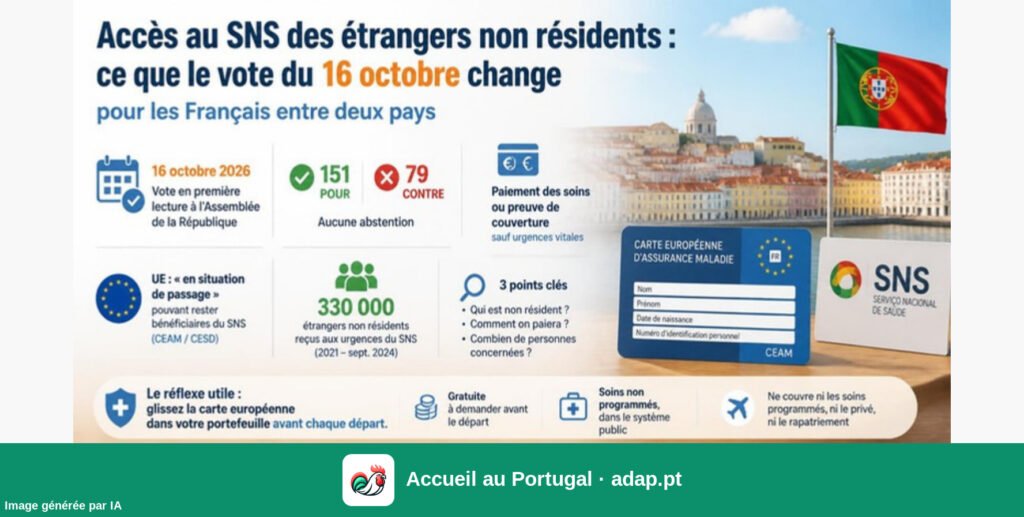
On 16 October, the Assembly of the Republic approved at first reading a bill tabled by the PSD and the CDS-PP which makes access to the Serviço Nacional de Saúde for non-resident foreigners conditional upon payment for treatment or the provision of cover. Are French nationals who live between France and Portugal affected? The text provides some answers, but several points remain to be decided in committee.
151 votes in favour, 79 against, no abstentions: on 16 October 2026, the Assembly of the Republic approved at first reading (‘na generalidade’) Bill No. 786/XVII/2, tabled on 25 September by the PSD and CDS-PP groups. It amends Article 21 of the Basic Health Act (Act No. 95/2019): non-resident foreign nationals who are not beneficiaries of the National Health Service (SNS) will have to pay for the healthcare they receive or prove that they are covered. The PSD, the CDS-PP and Chega voted in favour; the PS, the IL, Livre, the PCP, the BE, the PAN and the JPP voted against. The text has not yet become law.
What the text provides for
As currently drafted, Base 21 includes third-country nationals and migrants amongst the beneficiaries of the National Health Service, even ‘sem a respetiva situação legalizada’ (without legalised status), as the explanatory memorandum to the draft bill points out.
The draft replaces this list. In addition to Portuguese nationals, those eligible would include foreign nationals ‘who are lawfully resident in the country or who hold a temporary stay or residence permit in Portugal’, whether they are citizens of the European Union or equivalent, nationals of third countries, stateless persons or applicants for international protection.
For others – those staying in the country illegally and non-residents ‘not covered by paragraph 2’ – access to the National Health Service (SNS) ‘requires payment for the care provided, in accordance with the law, or the presentation of proof of health insurance cover’, i.e. payment for the care or proof of cover, as well as identity and contact details. ‘Emergency or urgent and life-saving’ care remains guaranteed; supporting documents are then requested retrospectively.
On the same day, MPs approved at first reading a bill tabled by Chega (No. 638/XVII) which targets non-resident nationals from countries outside the European Union who are admitted to the National Health Service (SNS) ‘upon payment for the services received’. They also adopted two resolutions: the PS resolution calls for a review of non-residents’ access to the National Health Service (SNS), to be submitted within 90 days; the IL resolution recommends collecting fees before treatment is provided, or requiring a deposit, when the patient pays out of their own pocket.
Why this text now?
The bill essentially incorporates Bill No. 384/XVI, which was approved at first reading in December 2024 but subsequently lapsed following the early dissolution of Parliament. Its explanatory memorandum cites a report by the General Inspectorate of Health Services (IGAS) dated 27 November 2024: between 2021 and September 2024, approximately 330,000 non-resident foreign nationals were treated in the A&E departments of the National Health Service (SNS), of whom more than 140,000 had neither insurance nor an international agreement covering their healthcare.
For its part, the government relies on data from the ACSS, the central administration of the health system: out of more than 19.3 million registrations with the SNS, ‘around 4.4 million do not have complete identification details’.
The French caught between two countries: what the text says
If you are legally resident in Portugal, you will continue to be covered by the SNS: the bill expressly provides for this.
If you live in France and spend a few weeks or months a year in Portugal, the text appears to include you amongst those eligible: it refers to European Union nationals as being ‘em situação de estada’, that is to say, visiting, ‘nos termos do regime jurídico aplicável’. For someone insured under the French scheme, this refers to the European Health Insurance Card (EHIC), known in Portugal as the ‘Cartão Europeu de Seguro de Doença’. It entitles you to treatment that cannot wait until your return, within the public healthcare system, with the same rights as Portuguese insured persons. This point will need to be confirmed in committee.
The explanatory memorandum focuses primarily on ‘non-resident third-country nationals’ and states that it does not seek to ‘remove or diminish any rights of legitimate beneficiaries of the National Health Service (SNS)’. Chega’s draft, on the other hand, concerns only nationals of countries outside the European Union. The text put forward by the PSD and the CDS-PP, which amends only Base 21, makes no mention of the EHIC.
What remains to be decided
The vote on 16 October is just one step. The bill was referred back to the Health Committee on the same day for clause-by-clause scrutiny (‘especialidade’), where it may be amended and brought more into line with Chega’s text. This will be followed by the final vote on the bill as a whole. The text is due to come into force the day after its publication.
Three points remain unresolved:
- Who is a non-resident: the draft uses the terms ‘estada’ and ‘residência temporária’ without defining them.
- How payment will be made: the text defers to a subsequent law the identification of payers, the collection of payments and, ‘quando necessário’, a ‘guarantee, advance payment or other means of ensuring the respective payment’.
- How many people are involved: the review requested by the Socialist Party must provide figures on the number of non-residents receiving treatment, the treatment received and its cost.
For French people who divide their time between the two countries, there’s no need to wait for the parliamentary debate to end before taking practical action: simply slip your European card into your wallet before each trip.
Practical information
The European Health Insurance Card
- It is free of charge; check with your health insurance provider before you set off; be wary of websites that charge for it.
- It covers treatment that cannot wait until your return, within the public healthcare system, with the same entitlements as Portuguese insured persons.
- In Portugal, take it to a health centre (‘centro de saúde’) or an SNS hospital, where it is referred to by the acronym CESD.
- It does not cover scheduled treatment, the private sector or repatriation.
Last updated: 22/10/2026
Article written with the help of artificial intelligence, proofread, edited and approved by François Wilman.
This article has been written with the utmost care, but may contain errors or out-of-date information. Always check important information against official sources before using it.
This article has been automatically translated from French for your reading convenience. Only the French version is legally binding.